



Concealed Hinges Explained: Types, Crank Sizes & How to Choose the Right One

Choosing the right hinge is one of the most important details in cabinet and furniture construction. A hinge affects more than just how a door opens and closes—it also influences door alignment, overlay, appearance, installation, and everyday usability.
Among the most widely used options in modern cabinetry are concealed hinges, also known as European-style or cup hinges. Unlike traditional exposed hinges, concealed hinges are largely hidden when the cabinet door is closed, creating a clean and contemporary appearance.
However, choosing the correct concealed hinge is not simply a matter of selecting a hinge that fits the cabinet. Factors such as crank size, overlay, opening angle, cup size, door thickness, mounting plate, and soft-close functionality all need to work together.
This guide explains concealed cabinet hinges in simple terms and provides a practical framework for selecting the right one for kitchens, wardrobes, cabinets, office furniture, and other furniture applications.
What Are Concealed Hinges?
A concealed hinge is a furniture hinge designed so that most of its mechanism is hidden between the cabinet door and cabinet body when the door is closed.
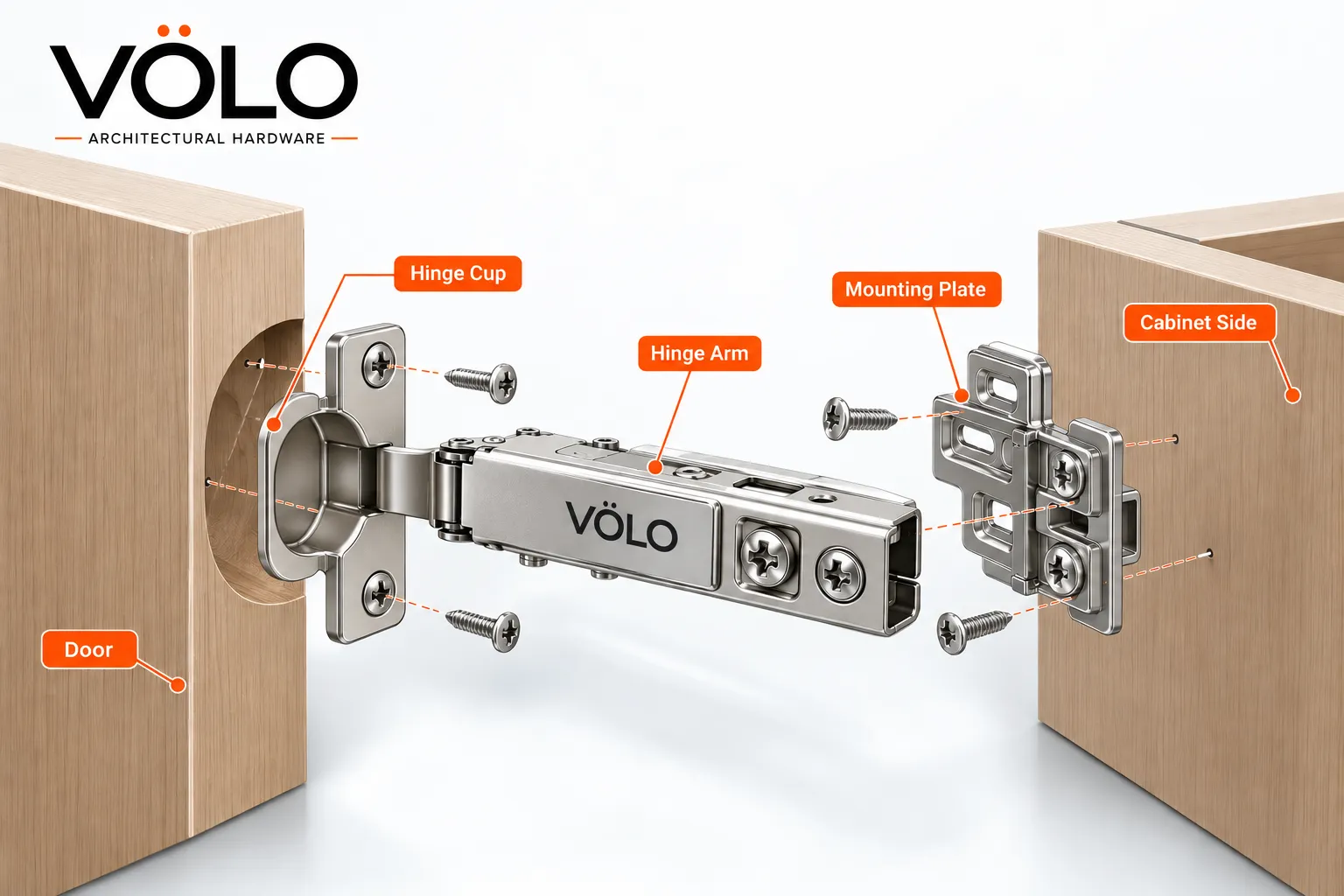
A common concealed hinge consists of three main parts:
- Hinge cup: The circular section fitted into a recess, or cup hole, in the back of the door.
- Hinge arm: The moving section connecting the cup to the mounting plate.
- Mounting plate: The component fixed to the cabinet side or frame.
When the door opens, the hinge mechanism pivots and allows the door to move away from the cabinet. When closed, the hardware is largely hidden behind the door.
The exact construction varies between hinge designs, so installation dimensions and drilling requirements should always be checked against the relevant product datasheet.
Why Are Concealed Hinges Commonly Used in Modern Furniture?
Concealed hinges are popular because they combine practical door movement with a relatively clean exterior appearance.
They are commonly used in:
- Modular kitchens
- Wardrobes and cupboards
- Bathroom cabinets
- TV units
- Office storage
- Bookshelves
- Residential cabinetry
- Commercial furniture
A concealed hinge also allows manufacturers and carpenters to make adjustments to door positioning on many modern hinge systems. Depending on the design, these adjustments can help correct small differences in height, side alignment, and depth.
Volo’s current concealed-hinge listings include products such as soft-close concealed hinges, 3D adjustable hinges, corner hinges and other concealed-hinge configurations. Exact features vary by model and should be confirmed from the individual product information before selection.
Main Types of Concealed Hinges
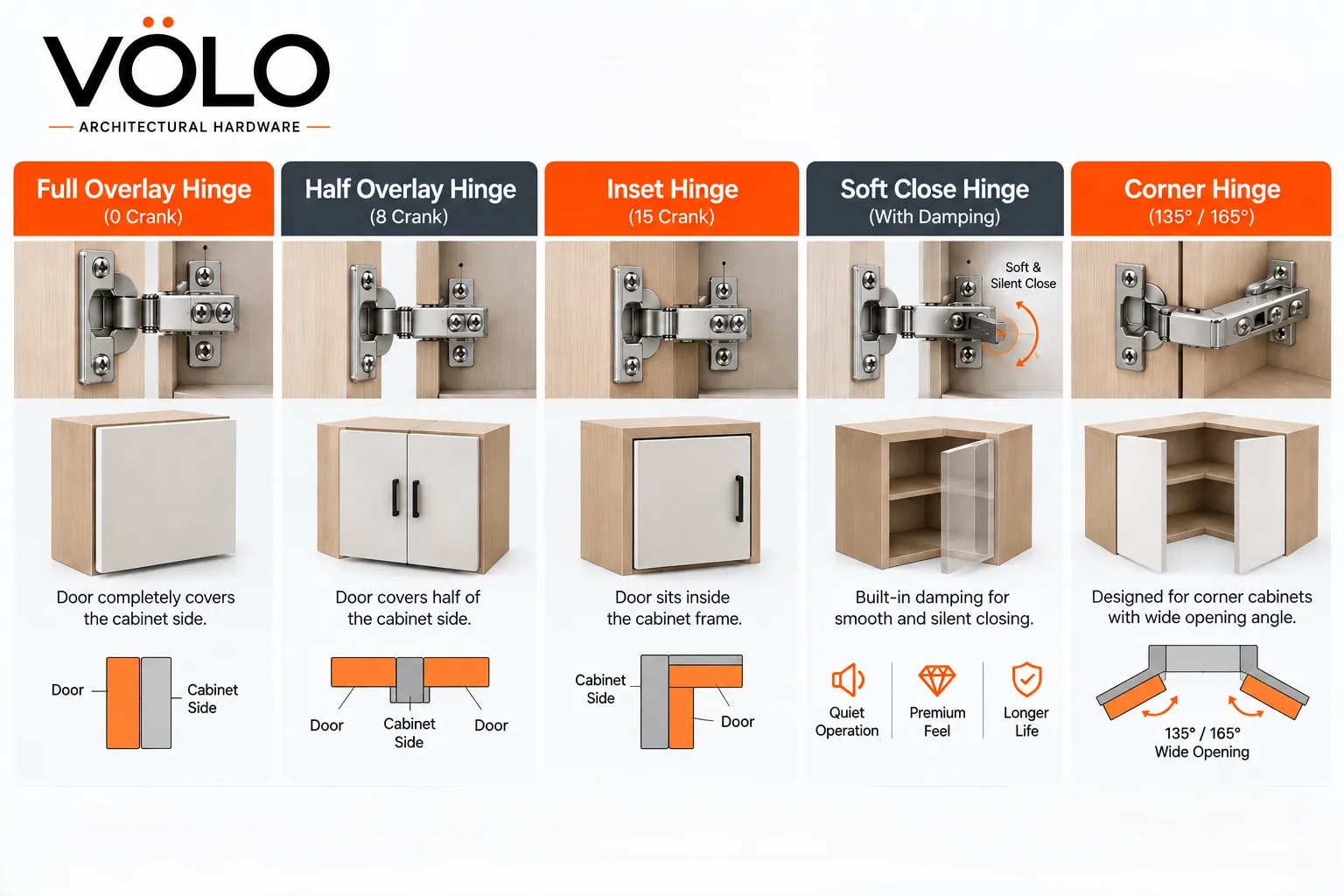
Not every cabinet requires the same hinge. Concealed hinges can be differentiated according to the door position, cabinet construction, opening requirement, and closing mechanism.
1. Full-Overlay Concealed Hinges
A full-overlay hinge is used when the cabinet door substantially covers the front edge of the cabinet side or partition.
This configuration is common where the furniture design calls for a relatively continuous door front with minimal visible cabinet framing between adjacent doors.
Best suited for
- Kitchen cabinets
- Wardrobes
- Full-overlay cabinet doors
- Contemporary furniture
When selecting this type, the hinge crank and mounting arrangement must correspond with the intended overlay.
2. Half-Overlay Concealed Hinges
A half-overlay hinge is used where two cabinet doors share a cabinet partition and each door covers only part of the partition.
This arrangement is useful for furniture where two doors are mounted on opposite sides of the same cabinet divider.
Best suited for
- Double-door cabinets
- Modular furniture
- Cabinets with shared partitions
- Wardrobes with specific door layouts
The exact overlay depends on the hinge geometry, mounting plate and door construction, so it should be calculated or confirmed rather than assumed.
3. Inset Concealed Hinges
With an inset hinge arrangement, the door sits inside the cabinet opening rather than substantially covering the cabinet front.
This produces a different visual effect from full-overlay furniture and requires a hinge geometry that accommodates the inset position.
Best suited for
- Inset cabinet doors
- Traditional or contemporary furniture designs
- Special cabinet constructions
- Projects where the door needs to sit within the cabinet frame
4. Soft-Close Concealed Hinges
A soft-close hinge incorporates a damping mechanism that controls the final part of the door-closing movement.
Instead of the door closing abruptly, the damper slows its movement towards the closed position.
Soft-close concealed hinges are particularly useful for frequently used furniture such as kitchens, wardrobes and storage cabinets.
Volo currently lists concealed soft-close hinge products, including 3D clip-on models. Its published product information specifies that features such as adjustment, opening angle and suitable door thickness are model-dependent.
5. Clip-On Concealed Hinges
A clip-on hinge is designed to attach to a compatible mounting plate through a clipping mechanism.
One advantage is convenience during installation or removal, particularly when furniture requires repeated door fitting and adjustment.
However, compatibility between the hinge and mounting plate is essential. A clip-on hinge should not be assumed to fit every mounting plate.
6. Special-Application Concealed Hinges
Some furniture designs require specialised hinge geometry.
Examples include:
- Corner cabinet hinges
- Wide-opening hinges
- Thick-door hinges
- Hinges for unusual cabinet constructions
For example, Volo lists corner concealed hinges with wide opening configurations for applications such as corner cabinets and storage units. The exact opening angle and installation requirements should be checked for the selected model.
What Is Hinge Crank Size?
One of the most confusing terms for new hinge buyers is crank size.
In simple terms, the crank describes the offset or bend in the hinge arm. It influences how the door sits in relation to the cabinet and is closely related to the intended overlay or inset arrangement.
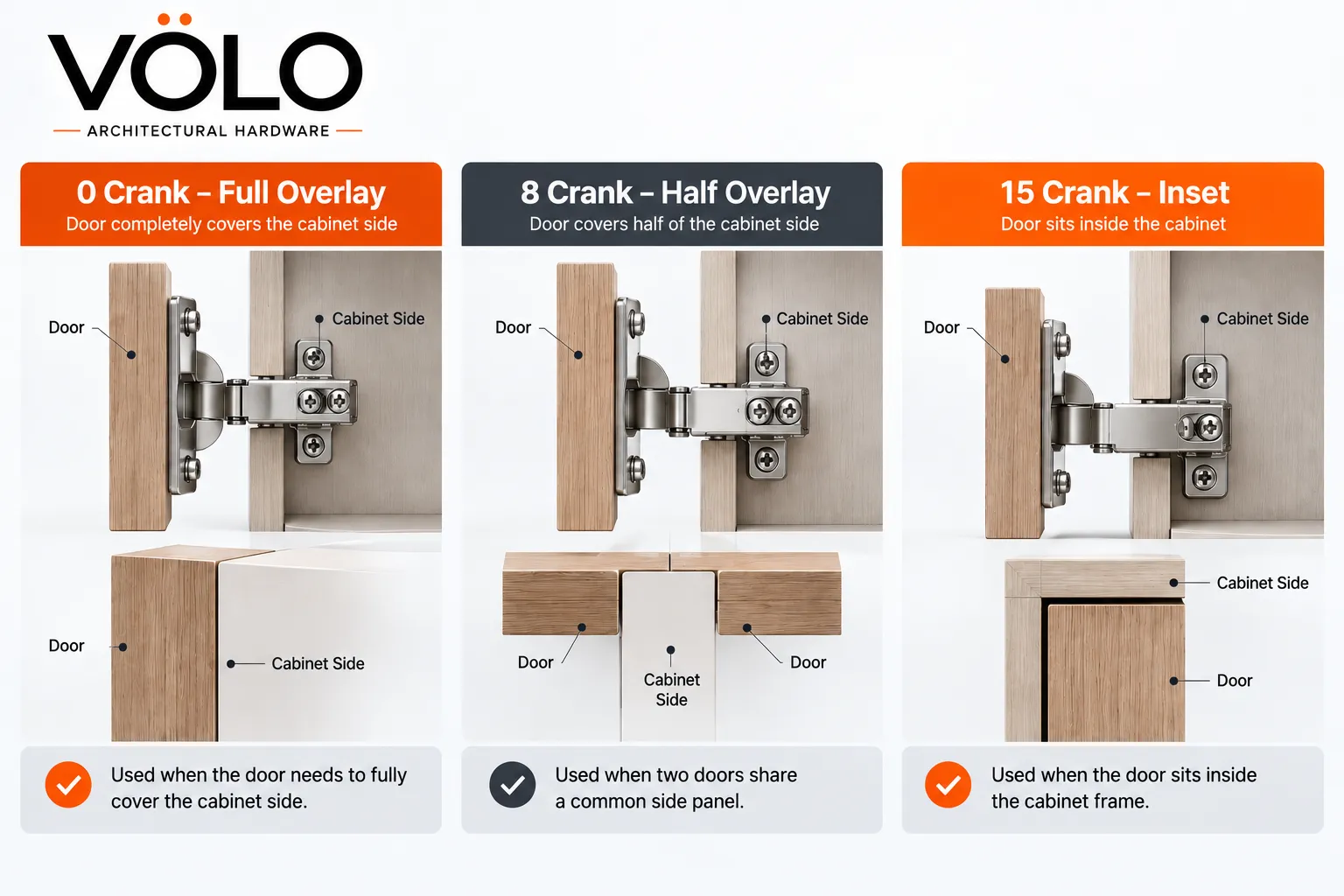
Volo’s current concealed-hinge listings include 0 Crank, 8 Crank and 15 Crank variants.
Rather than thinking of crank numbers as automatically meaning a particular overlay measurement, it is better to understand them as different hinge-arm geometries designed for different door-positioning requirements.
0 Crank
A 0-crank or straight-arm configuration is commonly associated with a full-overlay application.
The door is positioned so that it covers the cabinet side substantially when closed.
8 Crank
An 8-crank configuration provides a greater offset in the hinge arm.
It is commonly associated with half-overlay applications, where the door arrangement requires a different relationship to the cabinet partition.
15 Crank
A 15-crank configuration has a greater offset and is commonly used for inset applications, where the door sits within the cabinet opening.
Volo’s published catalogue identifies its 0°, 8° and 15° concealed-hinge variants as Full, Half and Inset respectively.
Why Crank Size Matters
Selecting the wrong crank can cause problems such as:
- Incorrect door overlay
- Door sitting too far inside or outside the cabinet
- Difficulty aligning adjacent doors
- Uneven gaps
- Interference between doors and cabinet components
- Problems during installation
Important: Crank size should not be selected in isolation. The final door position depends on the hinge geometry, mounting plate, cup position, door thickness and cabinet construction. Always check the relevant hinge drilling and overlay information for the selected model.
Concealed Hinge Specifications You Should Check
Before purchasing cabinet hinges, review the following specifications.
Opening Angle
The opening angle determines how far the door can swing.
Common furniture hinges may be designed for different opening angles, while special hinges can provide wider access for applications such as corner cabinets.
Choose the opening angle according to the cabinet layout and how much access is required.
Overlay
Overlay describes how much the cabinet door covers the cabinet side or frame when closed.
Overlay is one of the most important dimensions when selecting a concealed hinge because it determines where the door sits relative to the cabinet.
Do not confuse overlay with crank size. Crank geometry contributes to the door position, but the final overlay also depends on the mounting plate and installation dimensions.
Cup Size
The hinge cup is the circular section recessed into the back of the cabinet door.
Many concealed cabinet hinges use a standard cup format, but buyers should always verify:
- Cup diameter
- Cup depth
- Cup drilling pattern
- Distance from the door edge
Do not drill a cabinet door based solely on a generic assumption about cup dimensions.
Soft-Close or Non-Soft-Close
Decide whether the door needs controlled closing.
Soft-close hinges use a damping mechanism, while non-soft-close hinges do not provide the same integrated closing control.
For kitchens and wardrobes, soft-close functionality can be useful where doors are opened and closed frequently.
Material and Finish
The material affects the hinge’s construction and suitability for the intended environment.
Finishes may also influence appearance and resistance to environmental conditions.
For areas exposed to humidity, such as kitchens and bathroom furniture, check the manufacturer’s material and finish information rather than assuming that every plated or coated hinge has the same environmental performance.
Door Thickness
The door must be compatible with the selected hinge.
Door thickness can affect:
- Cup installation
- Door-edge clearance
- Hinge movement
- Overlay
- Mounting position
Some specialised concealed hinges are designed for thicker doors. Volo’s product catalogue includes a separate thick-door soft-close hinge category, demonstrating why door thickness should be considered before ordering.
Load and Capacity
A hinge must be appropriate for the size and weight of the door.
The total door load is also influenced by the number of hinges used and their positioning.
Never choose hinges solely by appearance. For larger or heavier doors, check the manufacturer’s recommended application and installation guidance.
Mounting Plate Compatibility
The mounting plate connects the hinge to the cabinet.
A hinge and mounting plate must be compatible in terms of:
- Mounting method
- Hole pattern
- Height
- Adjustment system
- Hinge design
If the hinge is clip-on, verify that the mounting plate is specifically compatible with it.
How to Choose the Right Concealed Hinge

A practical selection process can prevent most common mistakes.
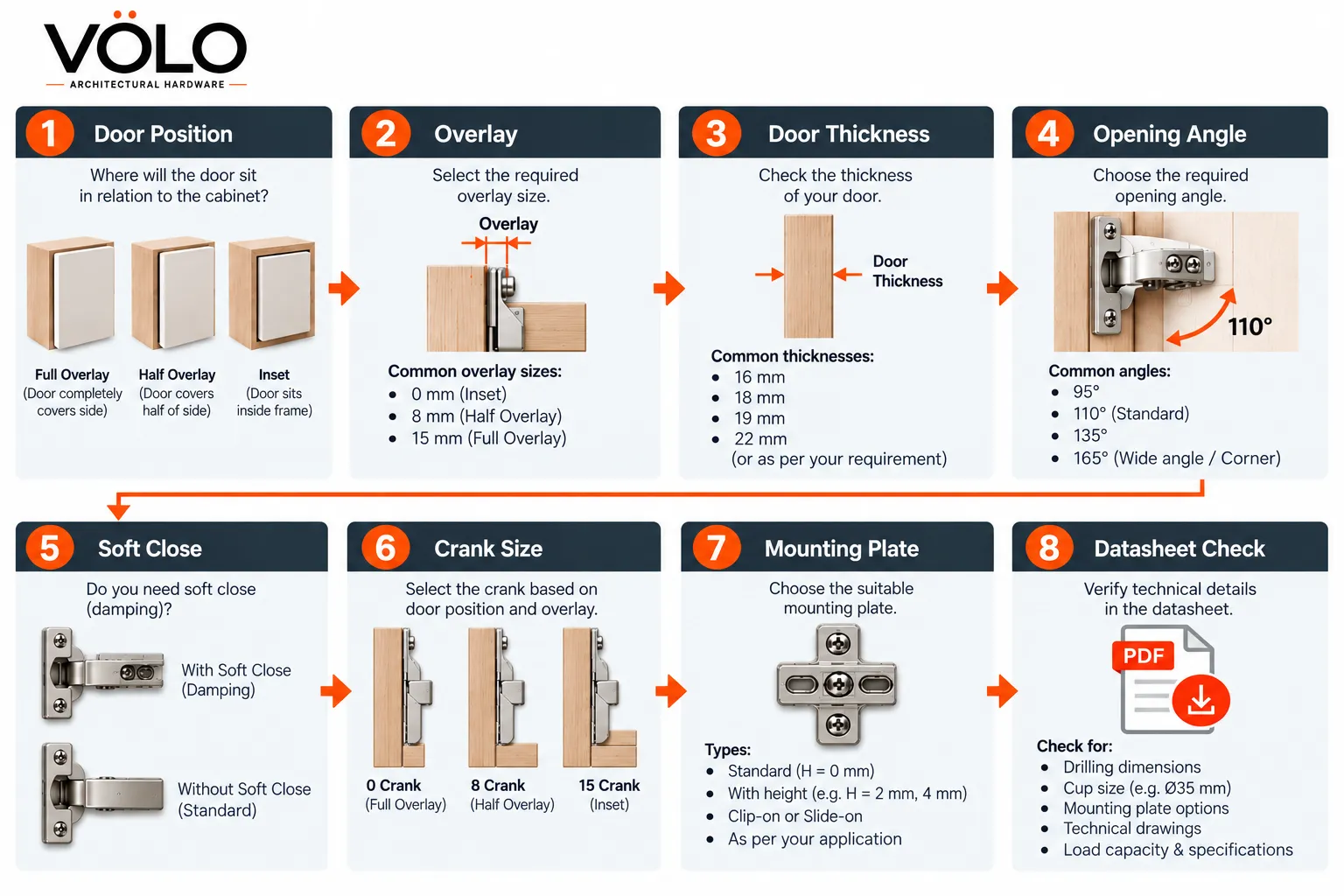
Step 1: Identify the Door Position
First decide whether the door will be:
- Full overlay
- Half overlay
- Inset
This immediately narrows the appropriate hinge-arm configuration.
Step 2: Measure the Door
Record:
- Door height
- Door width
- Door thickness
- Approximate door weight
These measurements help determine the appropriate hinge type and quantity.
Step 3: Check the Cabinet Construction
Look at the cabinet side, central partition and frame arrangement.
A single cabinet door mounted on the cabinet side may require a different configuration from two doors sharing a central partition.
Step 4: Decide on the Opening Angle
Determine how far the door needs to open.
For a standard cabinet, a conventional opening angle may be sufficient. Corner or specialised cabinets may require a wider-opening hinge.
Step 5: Choose Soft Close or Standard
For frequently used furniture, consider soft close.
For simple utility furniture or applications where controlled closing is not required, a standard concealed hinge may be sufficient.
Step 6: Select the Crank
Choose the appropriate crank based on the required door position.
As a general starting point:
| Crank | Common Application |
|---|---|
| 0 Crank | Full overlay |
| 8 Crank | Half overlay |
| 15 Crank | Inset |
These are common configurations, but the exact application should always be verified against the selected hinge model and mounting plate. Volo’s published catalogue uses the same Full/Half/Inset association for its 0°, 8° and 15° variants.
Step 7: Verify the Installation Dimensions
Before drilling, confirm the manufacturer’s:
- Cup drilling dimensions
- Mounting plate position
- Required clearances
- Overlay information
- Door-thickness range
- Adjustment instructions
This final step is especially important because apparently similar hinges can have different installation requirements.
Common Concealed-Hinge Selection and Installation Mistakes
Choosing the Hinge Before Measuring the Door
Do not purchase hinges first and try to make the furniture fit afterwards.
Better approach: Measure the door, cabinet construction and intended overlay first.
Assuming Every 0 Crank Means Exactly the Same Overlay
Crank terminology provides a useful starting point, but overlay depends on more than the crank alone.
Better approach: Check the hinge manufacturer’s technical drawing or product datasheet.
Ignoring Door Thickness
A hinge may look suitable but still be inappropriate for a particular door thickness.
Better approach: Confirm the specified door-thickness range before drilling.
Mixing Incompatible Mounting Plates
A hinge and mounting plate need to work as a system.
Better approach: Verify mounting compatibility before installation.
Using the Same Hinge for Every Cabinet
Different cabinet constructions can require different hinge geometries.
Better approach: Consider the door position, cabinet layout and opening requirement for every application.
Drilling Without a Template or Dimension Check
An incorrectly positioned cup hole can make alignment difficult or even damage the door.
Better approach: Follow the selected hinge’s drilling dimensions and use an appropriate drilling guide or template where applicable.
Choosing Only on Price
A low initial price does not automatically make a hinge the best value.
Consider the required functionality, installation requirements, frequency of use and suitability for the application.
Quick Comparison Table
| Hinge Type / Configuration | Typical Door Position | Main Benefit | Typical Application |
|---|---|---|---|
| 0 Crank / Full Overlay | Full overlay | Maximises door coverage over cabinet side | Kitchen cabinets, wardrobes |
| 8 Crank / Half Overlay | Half overlay | Suitable where two doors share a partition | Double-door cabinets |
| 15 Crank / Inset | Inset | Allows door to sit within cabinet opening | Inset cabinetry |
| Soft-Close Concealed | Varies by crank | Controlled closing | Kitchens, wardrobes, frequent-use furniture |
| Wide-Angle / Corner | Application-specific | Greater access to cabinet interior | Corner cabinets |
| Thick-Door Concealed | Application-specific | Designed around thicker door construction | Special furniture applications |
FAQs
What is a concealed cabinet hinge?
A concealed cabinet hinge is a hinge designed to remain largely hidden between the cabinet door and cabinet body when the door is closed.
What does hinge crank size mean?
Crank size refers to the offset or bend in the hinge arm. It affects the relationship between the door and cabinet and is commonly associated with full-overlay, half-overlay and inset configurations.
Is a 0-crank hinge the same as a full-overlay hinge?
A 0-crank configuration is commonly used for full-overlay applications, but the exact overlay depends on the complete hinge and mounting-plate setup. Always verify the manufacturer’s specifications.
What is the difference between overlay and crank?
Overlay describes how much the door covers the cabinet side or frame. Crank describes the hinge-arm offset that helps position the door. They are related but not identical measurements.
Are soft-close concealed hinges worth using?
For frequently used furniture, soft-close hinges can provide a controlled closing action and may improve everyday usability. Whether they are appropriate depends on the project requirements and budget.
What cup size should I choose?
Cup size must match the selected hinge and the door’s drilling requirements. Do not assume that every concealed hinge uses identical cup dimensions.
Can I use one concealed hinge for every cabinet door?
No. Hinge selection depends on door size, thickness, weight, overlay, opening angle, cabinet construction and other factors.
How many concealed hinges does a cabinet door need?
The appropriate number depends on the door’s dimensions, weight, hinge specification and manufacturer recommendations. Larger or heavier doors may require additional support.
What should I check before drilling the hinge cup?
Check the hinge’s cup diameter, cup depth, drilling distance from the door edge, mounting-plate position, door thickness and required overlay.
Are concealed hinges adjustable?
Many modern concealed hinges provide some form of adjustment, but the number and direction of adjustments vary by model. For example, some Volo concealed hinges are specified with 3D adjustment. Always check the individual product datasheet.
Conclusion + CTA
The right concealed hinge is determined by the door position, overlay, crank size, opening angle, door thickness, cabinet construction, closing mechanism and installation requirements.
For a straightforward full-overlay cabinet, a suitable 0-crank configuration may be the starting point. A half-overlay cabinet may require an 8-crank configuration, while an inset door may call for a 15-crank configuration. If controlled closing is important, a compatible soft-close version can be considered.
The key is to treat these as selection guidelines rather than universal rules. Always confirm the dimensions and installation requirements for the exact hinge model before drilling or ordering in quantity.
For homeowners, carpenters, interior designers, architects and furniture manufacturers, taking a few measurements before purchasing can prevent alignment problems and unnecessary rework.
If you are planning a new cabinet, wardrobe, kitchen or furniture project, explore the concealed hinges and furniture hardware solutions available from Volo India and check the relevant product specifications for your application. Explore Volo India’s concealed hinges